
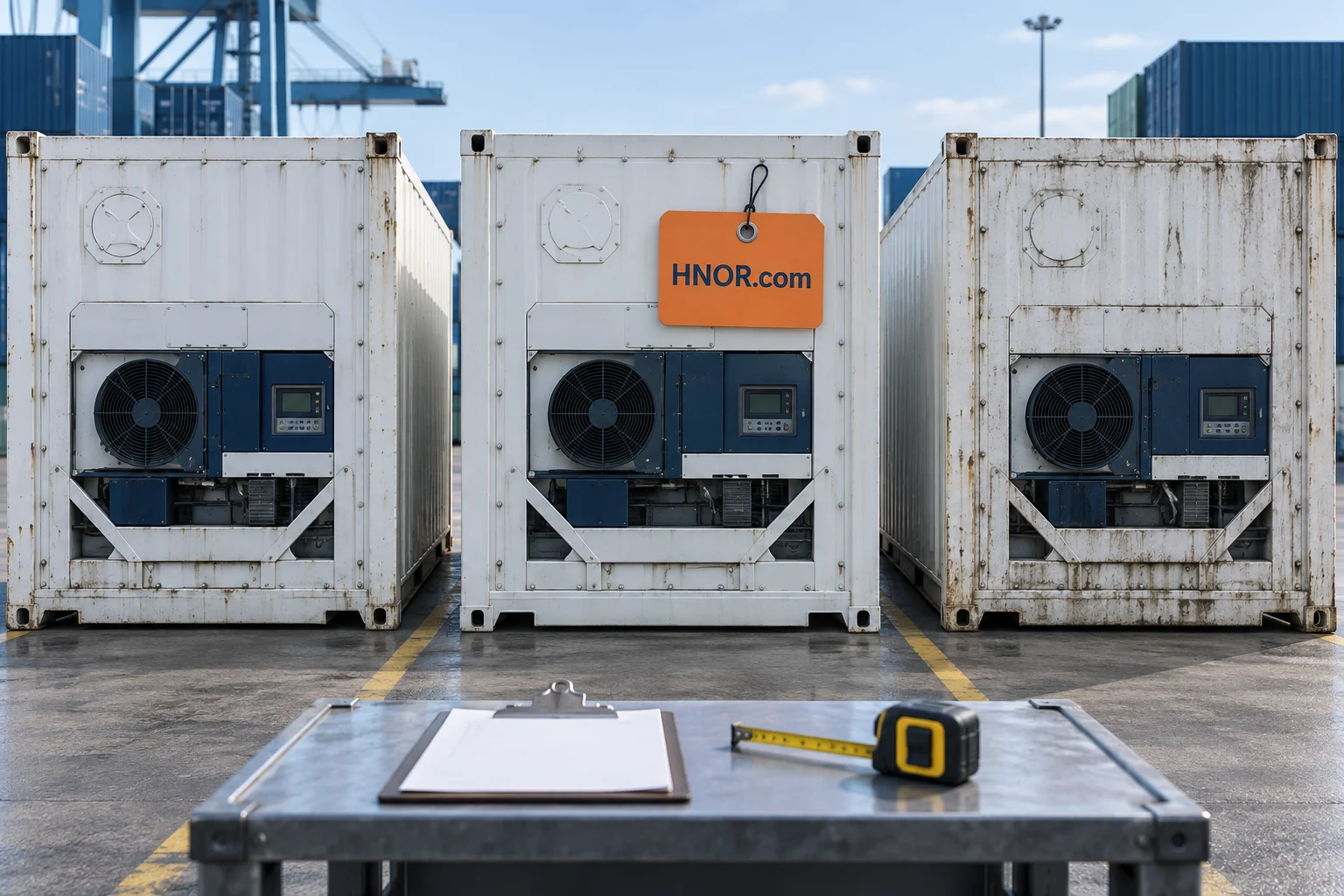
An illustrative business concept for HNOR.com. The domain is available for acquisition.
A used-equipment listing can look complete while answering almost none of the questions that decide whether a container is worth moving. One photo, a city, a length and a price leave the buyer to chase the real record through calls, messages and attachments. That gap is especially clear with HNOR equipment, where the label identifies a high-cube non-operating reefer but says little about the state of the individual unit.
DP World's HNOR definition gives the concept its starting point: refrigerated equipment that no longer operates as a cooling unit but may still serve a storage or transport role. A condition-led exchange would make the next questions part of the listing itself. It would not sell “a container.” It would present a reviewable equipment record linked to a real unit, location, controller and intended transaction.
Who would use it
The supply side could include container lessors, fleet owners, depots, refurbishers and sellers with off-hire or non-operating reefer units. The demand side could include buyers seeking insulated storage, logistics operators considering a permitted transport use, conversion specialists sourcing shells and parts buyers evaluating recoverable components.
Those groups do not share one definition of acceptable condition. A depot may focus on whether a unit can be safely lifted and released. A storage buyer may care about doors, moisture ingress, floor condition and delivery access. A converter may need structural drawings, insulation information and a clear account of refrigeration equipment that remains. The exchange should preserve those different decision paths rather than publishing one reassuring grade.
The first offer
The first useful product would be a structured listing package for one depot-to-buyer transaction. It could begin as a guided seller intake and a buyer-facing record. Better evidence and fewer hidden assumptions are enough to test before adding auctions, financing or a large inventory network.
Every listing would need six groups of information.
1. Identity and control
Record the complete container identification, the party authorized to offer it, the present depot or yard, and the person or organization that can approve release. Include a photograph of the full door end and close views of the identification and data plates. BIC's guide to container markings shows how identity, size and type, weights, capacity, height warnings and plate information can appear together. The platform should transcribe those fields while retaining the source images.
2. Physical specification
Store the full ISO size-and-type code, external dimensions, stated tare and any known modification. Do not let “high cube” stand in for a complete specification. The BIC size-and-type explainer separates length, height and equipment characteristics for a reason. A buyer needs the exact record used for transport planning and comparison.
3. Refrigeration-system status
Offer controlled choices such as present and untested, known non-functioning, isolated, partly removed or removed, with a dated note showing who supplied the information. “Non-operating” must not become “free of refrigerant” or “safe to dismantle” by inference. If disposal or system work is planned in the United States, the EPA's safe-disposal guidance explains that refrigerant recovery and documentation requirements can apply. Other jurisdictions will have their own rules.
4. Condition evidence
Use a fixed photo sequence for all corner castings, rails, posts, roof, side panels, understructure, doors, seals, floor, interior surfaces, drains and the machinery end. The sequence should capture observations, not produce a decorative gallery. Each defect gets a location, category, dimensions where applicable, close view, wider context view, inspector identity and inspection date.
The exchange should allow a qualified third-party report to be attached without pretending every seller checklist is equivalent. The Institute of International Container Lessors publishes separate inspection and repair guides for container equipment and refrigerated containers. That is a useful reminder that competent assessment depends on defined criteria, trained judgment and the proposed use.
5. Intended-use limits
A seller should state what is being offered: possible continued equipment use subject to inspection, stationary storage, conversion stock, parts recovery or another bounded purpose. The platform should ask what has not been evaluated. A unit offered for stationary storage should not quietly inherit a claim of fitness for international transport. A shell offered for conversion should not be described as building-ready.
6. Transaction and handoff
The listing should separate sale price from depot charges, taxes, loading, transport, permits, inspection costs and any machinery treatment. It should identify when risk and custody transfer, what release documents are required and how long the unit can remain at the site after purchase. Those details often decide whether an apparently inexpensive unit is workable.
A better comparison screen
Most marketplaces sort by price, location and size. An HNOR exchange could compare evidence completeness as well. A buyer might filter for units with a readable identity plate, a current dated exterior survey, documented machinery status, door and floor photos, release authority and a stated permitted-use category.
That is not a condition score. It is a record-quality view. Two units can have equally complete records and very different defects. The screen should show “documented” separately from “acceptable,” leaving the buyer and qualified inspector to judge the latter.
How one transaction could work
Consider an illustrative case: a depot has a 40-foot high-cube reefer that is no longer offered for active refrigerated service. The owner authorizes sale for stationary storage or parts recovery, subject to buyer review. The depot uploads the complete door markings, a current photo sequence and a machinery note from an identified technician. A separate inspector records corrosion at the lower side rail and a damaged door gasket. The seller states that lifting, haulage and local siting are excluded.
A prospective buyer can now see the unit's identity, location, evidence date, observed defects and commercial boundaries before arranging a site visit. The buyer commissions an inspection for the intended storage use, obtains a delivery quote and checks the proposed site's rules. Questions and revised documents remain attached to the same listing. At release, both parties receive a timestamped handoff record.
The exchange has not certified the container. It has made the evidence easier to inspect and the unresolved questions harder to miss.
Distribution that starts close to the equipment
The first users are more likely to come through depot and lessor relationships than a broad consumer advertising campaign. One practical launch would work with a small group of facilities willing to publish a consistent off-hire inventory record. Each facility gets a simple upload route, a clear correction process and a way to export the final transaction file.
Searchable guides can support that supply. A buyer who lands on an article about HNOR terminology should be able to see why a complete equipment record matters, then browse listings that meet the stated evidence baseline. Email alerts could be built around location, size, machinery state and intended use rather than vague “new container” notifications.
Responsibility cannot disappear into the interface
The International Maritime Organization's CSC overview says owners are responsible for maintaining and periodically examining safety-approved containers. A marketplace record does not take over that duty. Nor should the platform claim that a photograph establishes structural safety, cargo cleanliness or local permission.
Seller terms should require authority to list the unit and accurate disclosure of known information. Inspectors should be named with the criteria and scope they used. Buyers should acknowledge the intended use they are evaluating and commission the applicable professional checks. Corrections should remain visible with timestamps instead of silently replacing the earlier record.
The exchange would also need policies for title disputes, misidentified units, stale inspections, changed locations, unsafe pickup conditions and refrigerant-related documentation. Those policies are part of the product, not legal text added after launch.
A disciplined first build
The minimum test is one complete transaction, not a national catalog. Draft the listing fields, choose a photo sequence, define who can change each field and walk a real equipment journey from owner authorization through depot release. Note every place where the record depends on a phone call or an undefined term. That map will reveal which workflow the product should own first.
HNOR.com fits this concept because the name is narrow enough to set expectations. A condition-led exchange could begin with non-operating high-cube reefers, learn the evidence model deeply and expand only when another equipment category can be described with equal care.